
Imaginative, retrospective revalation of brutal
homophobic events in a young ménage-à-trois, based on love,
betrayal and revenge.
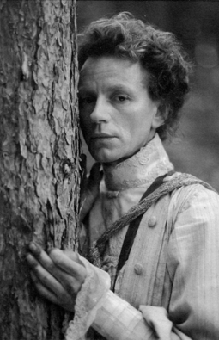 1952:
Bishop Bilodeau os to hear the last confession of the terminally ill prisoner
Simon Doucet. Having bribed some of the guards and secured the help of
the chaplain, around a dozen inmates lock the chapel and transform it into
a theatre. The bishop is forced to watch a dramatisation of his and Doucet's
lives in 1912, which had led to the incarceration of the now sick man.
The played-out scenes, in which the prisoners take over both male and female
roles, turn into real memories, but still with the prisoners playing their
parts. The love story between the young Simon Doucet and Count Vallier
de Tilly is gradually unfolded, and three factors enter into the plot.
Jean Bilodeau, unsure of his homosexuality, the French woman Lydie-Anne
de Rozier, and a society which does not understand gay love. No one taking
part knows the full story and how it ends and, as the truth is brought
to light, it is the bishop who makes a confession and may not come out
of it unscathed...
1952:
Bishop Bilodeau os to hear the last confession of the terminally ill prisoner
Simon Doucet. Having bribed some of the guards and secured the help of
the chaplain, around a dozen inmates lock the chapel and transform it into
a theatre. The bishop is forced to watch a dramatisation of his and Doucet's
lives in 1912, which had led to the incarceration of the now sick man.
The played-out scenes, in which the prisoners take over both male and female
roles, turn into real memories, but still with the prisoners playing their
parts. The love story between the young Simon Doucet and Count Vallier
de Tilly is gradually unfolded, and three factors enter into the plot.
Jean Bilodeau, unsure of his homosexuality, the French woman Lydie-Anne
de Rozier, and a society which does not understand gay love. No one taking
part knows the full story and how it ends and, as the truth is brought
to light, it is the bishop who makes a confession and may not come out
of it unscathed...
- John Greyson is a political filmmaker who has
been arousing attention for 16 years with partly fictional, falsified or
musical documentaries on subjects of lesbians & gays, workers, racism
and Aids (Zero Patience ). Today, in the late 90's, a time
when the North American continent is being swept by a tide of right-wing
anti-lesbian anti-gay Christian fundamentalism, he hits back with Lilies,
attacking the ignorance which misunderstands love and fosters intolerance.
As a basis for his film he uses Michel Marc Bouchard's stage play
of the same name, written in 1987 (the French title being Les Feluettes).
Although a theatrical atmosphere is deliberately recalled time after time,
Lilies is anything but a stage play. With imaginative and
playful innovations Greyson takes us into a world of images and imagination,
and surprises us with the natural and unreserved readiness of the inmates
to sympathise with homosexual love and to play the parts of women and gays.
Lilies is a movie work of art, in which the setting of a declaration of
love in a bath-tub in a prison chapel, or, as the case may be, in the middle
of a forest, captures the audience as much as the intensity of its interpersonal
feelings and tragic events does. New Queer Cinema
will be enriched by a new perspective from this hit from
Quebec.
- Lilies combines all the old themes of
gay cinema – homoerotica (including the masochistic element of Saint Sebastian),
prison, church, drag, love denied and social prejudices – with something
new, well within the artistic demands of New Queer
Cinema. This has already catapulted Lilies
to the distinction of being one of the most important gay films of the
coming season, and will appeal to more heterosexual audiences than is usual
in this genre.
Seen during the:
63rd MIFED 1996
copyright: Queer
View 1996
Filmdata
Deutsche Version